

How I Changed My Mind
Race, Geography and Growing Up New Orleans
“New Orleans is not in the grip of a neurosis of a denied past; it passes out memories generously like a great lord; it doesn’t have to pursue ‘the real thing.’”
— Umberto Eco
"Oh, yeah?"
-- The Author
Once upon a time, at the intersection of the New and the Old Worlds, a City was born.
You can go there today, if you can afford the gas, the plane-fares and the extravagant hotel duties. It’s called New Orleans.
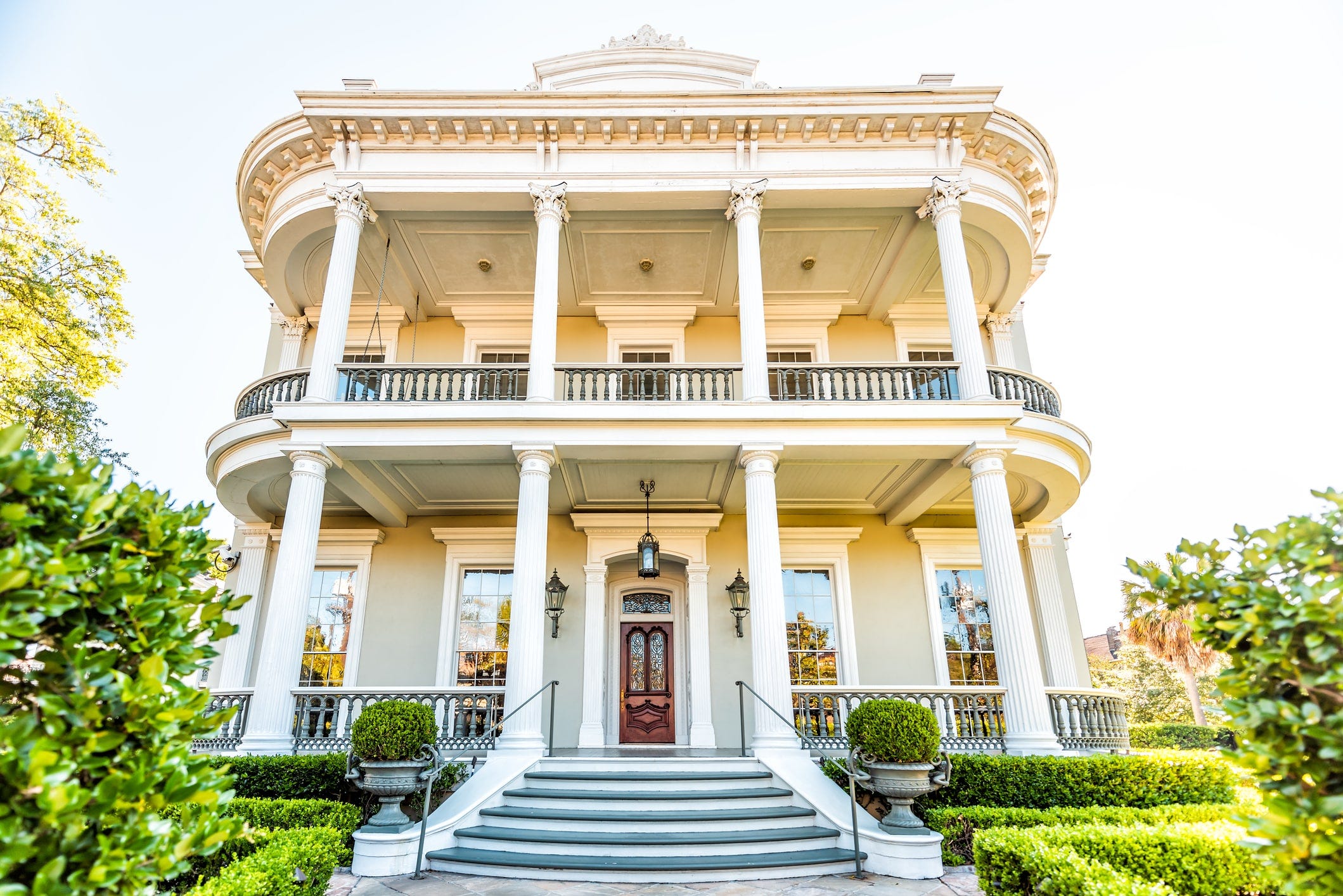
When you get there, ride the streetcar down St. Charles Avenue on your way to the Central Business District and the French Quarter. You’ll pass through the famous Garden District. Looking to your right, you see tall houses, breathing a 19th century air, painted in pastels and resembling complicated pastries. Ironwork wreathes around balconies. Extensive gardens, unlike the cramped courtyards of the French Quarter, give the district its name.
And until the year 2017 you knew your streetcar was passing out of the Lower Garden District and into the Central Business District because you rounded a sixty-foot high column upon which stood a sixteen-foot high statue of Confederate General Robert E. Lee, placed there by a committee of segregationists in 1876. (One of them, Charles E. Fenner, was a Louisiana Supreme Court justice who would go on to write the opinion in Plessy v. Ferguson that established the “separate but equal” doctrine.)
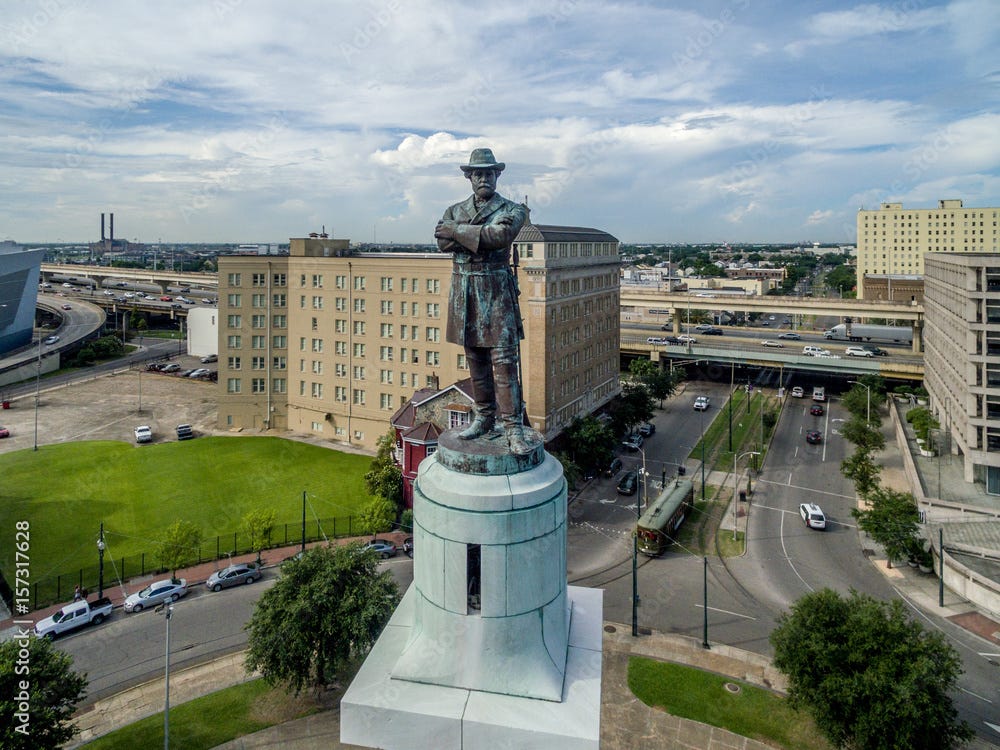
Lee’s statue is gone now, but those of who grew up with him overlooking the City know that the spot where he stood marks an intersection of geographies, a crossroads of race and cultures.
The statue was a marker, but those geographies predated it, and they predated Lee.
Before Lee, before the Civil War, the neighborhood known as the Garden District grew up as the American Quarter.
By the time of the Louisiana Purchase in 1803, the Spanish and French Creoles had settled along the Vieux Carre and Esplanade. They occupied the flood-resistant high-ground along the River, spreading out through the lowlands and along the Lake, and they still do today.
The free people of color lived mostly in what would become Tremé, Bywater, and the Marigny neighborhoods and the exclave of the St. John neighborhood.
The Irish and German immigrants planted themselves in what would become The Irish Channel and the Holy Cross neighborhoods and began cultivating a unique working-class culture complete with its own accent and idioms: their neighborhoods were home to the Yats, derived from the common greeting, “Hey, dahlin’, where y’at?”
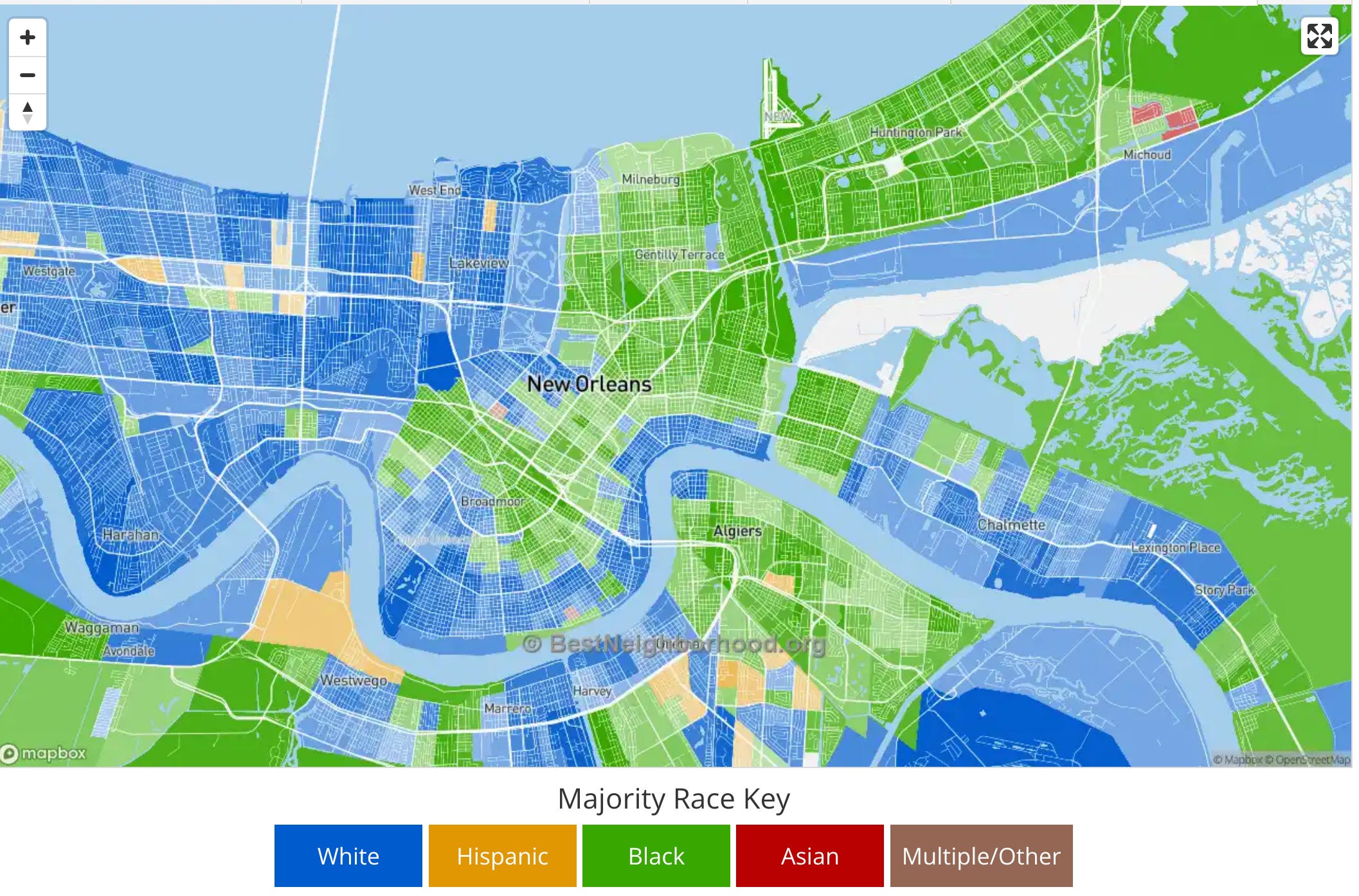
But the influx of American money from Out East (pretty much all of America was East of New Orleans at the time) lined itself up on the high ground between St. Charles Avenue and the River, constructing the ancestors of the mansions, and racial neighborhoods, you see there today.
The Americans set about forming business alliances with the established Creoles further downriver that would eventually enrich both worlds. Certainly there was snobbery and religious mistrust running both ways. But the old Catholic Creole families (from which I descend on my father’s side) couldn’t ignore American Protestant cash; and Americans couldn’t ignore that Creoles understood how religion and politics and cotton and sugar and power flowed through the place in unusual ways. You got rich here less by the Protestant work-ethic than by knowing who was who in the business aristocracy and in the State House, by maneuvering and manipulation. It has been said with some justice that New Orleans was, and remains, the northernmost Banana Republic. Certainly when Andrew Jackson was called to defend the City against a British Invasion in 1814-1815, he leveraged unconventional and probably extra-legal pardons for privateers to great effect. Jean Lafitte’s lieutenant Dominique You proved such a gifted artillery captain at the Battle of New Orleans that Jackson called him “gallant,” a rare encomium from Jackson.
This marriage of American and Creole could be a fruitful alliance.
Everyone knew that the first celebration of Mardi Gras in Louisiana was in 1699, by the explorers Iberville, Bienville and their men, and that Carnival was celebrated every year as a kind of semi-organized street-festival; but it wasn’t until 1856 that The Mistick Krewe of Comus was founded, by English-speaking businessmen who were appropriating the Catholic French and Spanish carnival. They organized it, regularized it, turned it into a social industry, and that began the annual extravagant but highly organized celebrations we know today.
The alliances between the Creoles and the Americans did depend on one inescapable thing, though, and when you grow up in the twilight of that world you often can’t see it because it was always the dirty, shameful secret of the City: it all depended on a belief in the superiority of the White race.
That includes, but hardly begins or ends, with slavery. The Mistick Krewe of Comus, confronted in 1991 with a City Council edict refusing permission to parade if they did not integrate, chose not to parade, or to integrate. (Its public face, The Pickwick Club, hosted a Mardi Gras day-party where, as a child, I raided the snack table before parades.)
But that’s just rich people being rich.
Let’s start with Presbyterianism.
Keep reading with a 7-day free trial
Subscribe to Otter Hat to keep reading this post and get 7 days of free access to the full post archives.